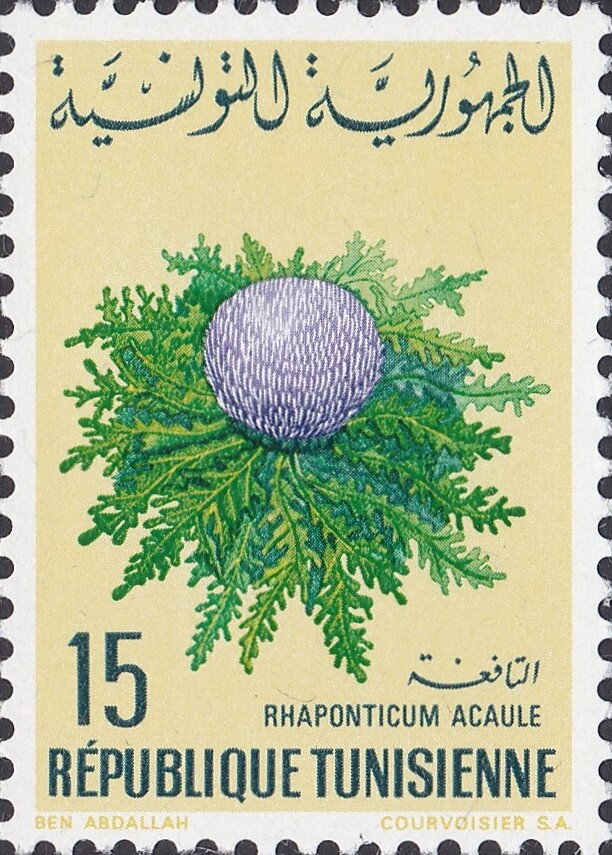
Stemless Rhaponticum
This stamp highlights the Rhaponticum acaule, a perennial herbaceous plant of the Asteraceae family, better known in Tunisia under the vernacular name “Tafgha”. Characterized by its absence of apparent stem (hence the term stemless), it presents itself in the form of a rosette of deeply cut leaves in the center of which sits a voluminous flower head, generally purple or purple in color. This species is indigenous to the Maghreb and adapts particularly well to clay soils and semi-arid environments, forming an integral part of the wild flora which flowers at ground level in the Tunisian plains and hills during spring.
Beyond its botanical aspect, Rhaponticum acaule occupies a special place in local traditions and popular pharmacopoeia. The receptacle of its flower, fleshy and tasty, is sometimes consumed by rural populations like a small wild artichoke, while its roots are renowned for various traditional medicinal virtues. By devoting this program to “Tafgha”, the Republic promotes an authentic element of the Tunisian terroir which symbolizes the resilience of plant life in the face of Mediterranean climatic conditions. This stamp thus transforms a common wild plant into a witness to the biological richness and ancestral knowledge linked to the Tunisian land.
Beyond its botanical aspect, Rhaponticum acaule occupies a special place in local traditions and popular pharmacopoeia. The receptacle of its flower, fleshy and tasty, is sometimes consumed by rural populations like a small wild artichoke, while its roots are renowned for various traditional medicinal virtues. By devoting this program to “Tafgha”, the Republic promotes an authentic element of the Tunisian terroir which symbolizes the resilience of plant life in the face of Mediterranean climatic conditions. This stamp thus transforms a common wild plant into a witness to the biological richness and ancestral knowledge linked to the Tunisian land.